
Hockley County Supervision Types
Parole and probation can both place a person under rules in the community, but the legal source and supervising office differ. The TDCJ Parole Division supervises people released from a Texas prison on parole or mandatory supervision. The Texas Board of Pardons and Paroles makes parole-release decisions. The Parole Division carries out supervision after release and helps process an approved release plan.
Probation is the common name for court-ordered community supervision. A judge may order it instead of a prison term or as part of a case disposition. Hockley and Cochran Counties share a Community Supervision and Corrections Department grouping in the state CSCD directory. A probation record therefore does not establish that someone first served a TDCJ sentence.
| Question | Parole | Probation |
|---|---|---|
| Who orders it? | Texas Board of Pardons and Paroles | Sentencing court |
| Who supervises it? | TDCJ Parole Division | Hockley County CSCD |
| What came before? | Release from state prison | A court disposition, which may not include prison |
| Best first record | TDCJ offender and parole information | Judgment or community-supervision order |
| End point | Sentence discharge or other lawful termination | Judge-ordered discharge or completion |
- Parole
- Conditional release from prison by a Board decision while the sentence continues.
- Probation
- Court-ordered community supervision administered by a local CSCD.
- Mandatory supervision
- A distinct TDCJ release category governed by time credits, eligibility rules, and in later cases Board review.
- Discharge
- Completion of the sentence or supervision term, not merely departure from a jail or prison.
Check Hockley County Supervision
Begin with the record that created the supervision. For a state-prison case, use the official TDCJ offender search. Match the person by TDCJ or SID number when possible, then check the release and parole-review information. A projected date or approval vote does not prove physical release. Review and Release Processing must audit the file, approve the release plan, and issue a release certificate.
For probation, read the signed judgment or community-supervision order. Hockley County District Court records and county-level case records may identify the order, term, and court. The CSCD can then confirm how its public contact process works. It should not be assumed that every supervision detail is public.
- Identify whether the case ended in a TDCJ prison term or a local court supervision order.
- Match a TDCJ record by number, SID, or exact birth date, not by name alone.
- For parole, check the release information and call the official status line if the record is unclear.
- For probation, obtain the signed court order and identify the supervising CSCD.
- Contact the assigned office with the person’s full name and the available case or TDCJ identifier.
- Ask whether the public record shows active supervision, a transfer, or discharge.
Hockley County Supervision Offices
Hockley’s two supervision routes lead to different offices. The statewide parole county table assigns Hockley cases to the Lubbock District Parole Office in Region V. The local CSCD handles probation ordered by a court. Confirm the office from the source record before calling, since a former TDCJ inmate who lives in Hockley may report through Lubbock.
The official Region V directory provides the current parole listing. The CSCD address comes from an older official state directory, so telephone verification is prudent before an in-person visit.
Lubbock District Parole Office
1720 East Regis Street
Lubbock, TX 79403
Phone: 806-747-8282
Fax: 806-747-8407
Hockley County CSCD
1212 Houston Street, Box 3
Levelland, TX 79336-3515
Phone: 806-894-9621
Fax: 806-894-7385
Call first to confirm current contact details.
The TDCJ county assignment screen is a useful check before contacting the parole office.
TDCJ’s Region V page shows the Lubbock office serving this route.
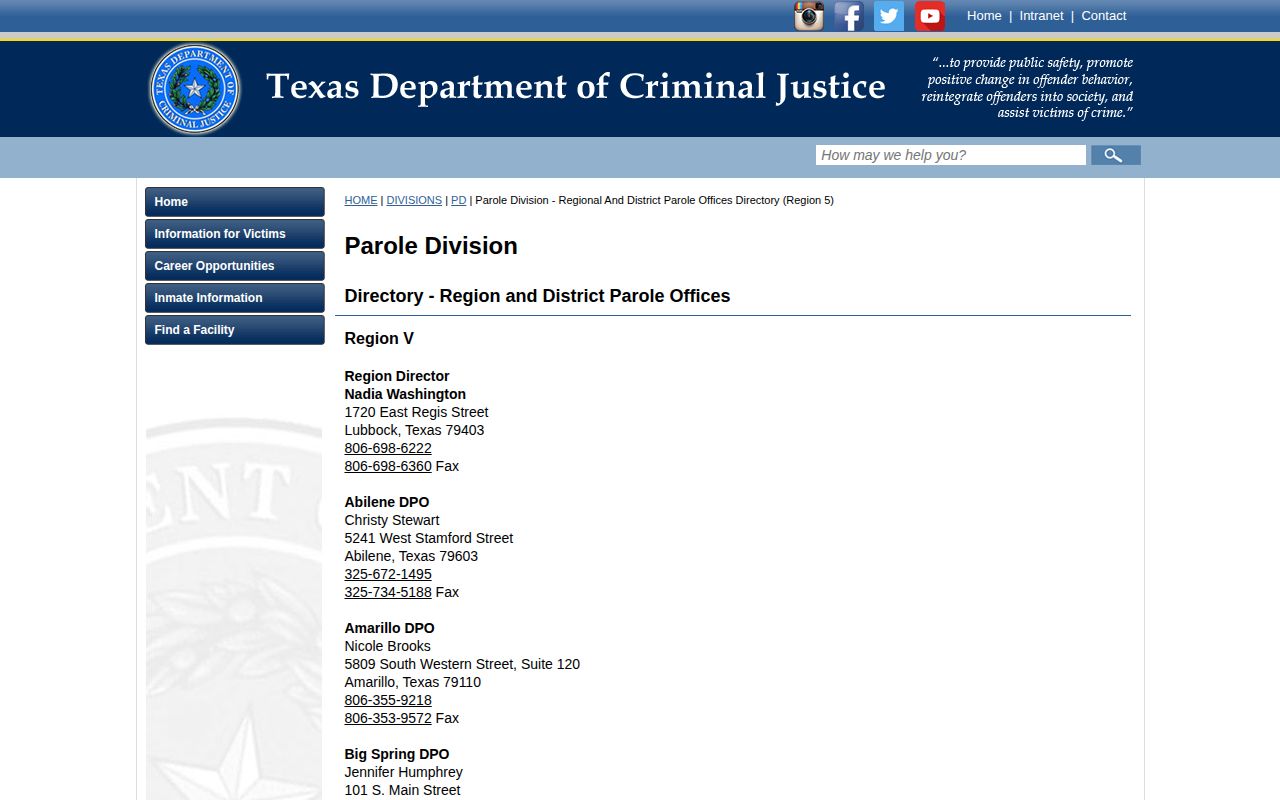
The image confirms that local residence does not mean the state parole office is located inside Hockley County.
Hockley County Parole Categories
TDCJ identifies parole, mandatory supervision, and discretionary mandatory supervision as distinct release categories. Parole is a discretionary Board decision. Mandatory supervision applies only to eligible cases under the law governing the offense date. For eligible offenses committed in the later statutory period, the Board reviews discretionary mandatory supervision rather than treating the time-credit date as an automatic release.
A favorable decision may still be subject to a program, release-plan review, residence approval, or other processing. The person has not necessarily left prison on the vote date. The Parole Division release-status line at 512-406-5202 applies after an approval vote. Before approval, the Board’s Offender Status Line is 844-512-0461. TDCJ requires a TDCJ number, SID number, or exact date of birth for telephone inquiries.
Discharge comes later. TDCJ defines a discharge date as the point when the sentence, including parole or mandatory supervision, ends. The site’s Hockley County released-inmate search and record path explains how that state record differs from a county-jail release sheet.
Note: An approval, eligibility date, projected date, and actual release are separate events and must be read as separate fields.
Hockley County Supervision Violations
Supervision conditions are the rules stated in the release certificate or court order. They may include reporting and other case-specific duties. The exact terms belong to the person’s official record. A violation allegation does not itself establish the final result, and a parole warrant does not prove that the person is now held in a jail.
An absconder is a person alleged to have stopped reporting or otherwise left supervision without authorization. TDCJ publishes a Sex Offender Absconder Information Search, but that tool has a narrow scope. It is not a public list of every Hockley County probation or parole absconder. Current custody should be checked with the agency that may hold the person, while supervision status should be checked with the assigned parole office or CSCD.
If a county-jail custody event matters, the current Texas IVSS-Counties portal may provide a status event when Hockley participates and the record is available. State-prison notifications use the separate TDCJ IVSS system. Neither notification system replaces the signed supervision order or the agency record.
Hockley County Supervision Discharge
Supervision can end through completion and discharge, or through another lawful order recorded by the responsible agency or court. For parole and mandatory supervision, a prison release date marks the start of community supervision, not the end of the sentence. TDCJ’s discharge record is the stronger source for completion of the full state term.
Probation ends under the court’s order and Texas Code of Criminal Procedure Chapter 42A. The case file may contain a discharge order or later court action. Obtain that signed record through the proper court rather than inferring completion from a missing online entry. Hockley County has separate county and district court trails, so the court named in the judgment controls where the record should be sought. A transfer of supervision to another county also should not be mistaken for discharge. The original case and receiving department may each hold part of the trail.
Keep identity and status questions narrow. Similar names, transferred supervision, and stale directory data can all produce false matches. The TDCJ identifier, case number, court, and date of birth make a reliable check far more likely. Record the date of each contact and the office that supplied the status, since an assignment or supervision term can change.